

The $600 Decision vs. the $7,000 Mistake
What Timing Belt Data Actually Shows About the Cost of Waiting
The Cost of Delaying Certain Maintenance
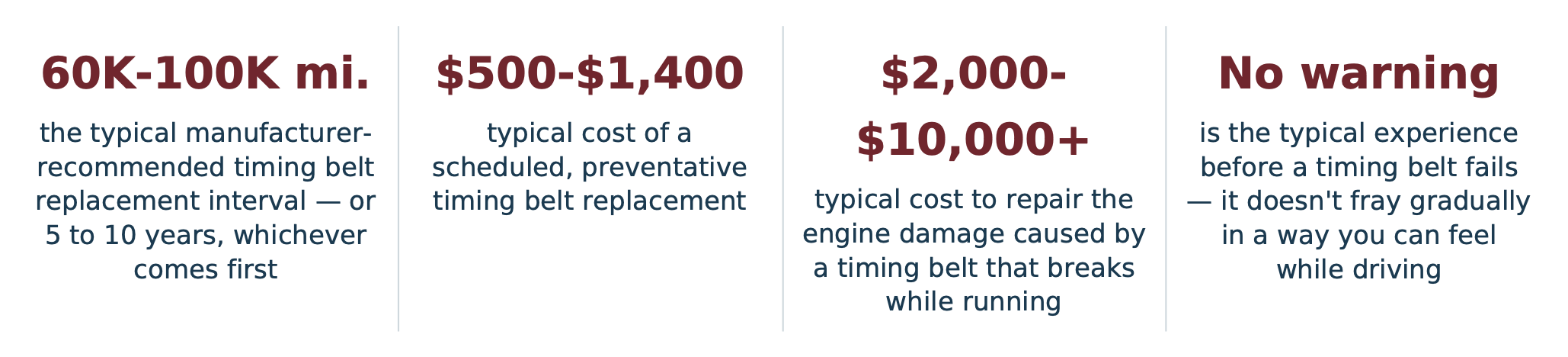
A timing belt doesn’t squeal. It doesn’t fray in a way you’ll feel at the wheel. It doesn’t give you a heads-up. On most modern vehicles, it simply breaks — without warning, while the engine is running — and on the majority of those engines, “breaks” means “causes thousands of dollars in internal damage.”
This study, compiled by Freehome Service Center in Cumming, Georgia, breaks down the real numbers behind one of the highest-stakes maintenance decisions a driver makes — and why “if it ain’t broke, don’t fix it” is exactly the wrong logic to apply here.
4 Key Stats
What the Data Shows — and Why It Matters for Forsyth County Drivers
Most scheduled maintenance items follow a simple logic: something wears visibly, a warning light appears, or a threshold number is easy to track. Timing belts work differently. The belt sits hidden behind covers at the front of the engine, can’t be meaningfully inspected without disassembly, and on most modern vehicles, shows no external sign of wear before it fails. It’s a critical component — it synchronizes the crankshaft and camshaft, keeping the engine’s valves and pistons operating in precise coordination — that is designed to be replaced on a schedule, not monitored for symptoms, because there aren’t any.
Manufacturer guidance is consistent across the industry: replace the timing belt at 60,000–100,000 miles, or at the 5-to-10-year mark by age, whichever threshold arrives first. That second condition — age — catches many drivers off guard. A vehicle that has sat in a garage or accumulated low miles is not exempt. The rubber compound in a timing belt degrades from heat cycling and time, not mileage alone.
The cost gap between acting on schedule and waiting is not incremental — it’s categorical. A scheduled replacement runs $500–$1,400 depending on the vehicle. A real-world example from Kelley Blue Book’s own repair estimator: a 2013 Ford Mustang timing belt job at an independent shop runs $573–$963 total, split between roughly $198–$232 in parts and $375–$423 in labor.
Wait until the belt breaks, and the math changes completely. The majority of modern vehicles use interference engine designs — engines where pistons and valves share the same physical space at different points in the rotation, held apart only by the belt’s precise timing. When that timing is lost, a piston strikes an open valve. Bent valves, damaged pistons, a potentially destroyed cylinder head. Repair estimates for that scenario run $2,000–$10,000 or more — and industry sources note that in many cases, the repair cost exceeds what the car is worth.
One additional data point most drivers miss: on many vehicles, the water pump is driven by the timing belt and sits behind the same covers. Skipping the water pump during a belt job to save approximately $100–$150 in parts can mean paying the full labor cost a second time when the pump fails — which, on an interference engine, carries its own catastrophic risk if it causes overheating or disrupts belt tension.
The study’s conclusion is direct: check both mileage and vehicle age against manufacturer intervals, replace the water pump at the same time if the access point is shared, and if you don’t know whether your engine is an interference design, treat it as one.
3 Takeaways for Cumming & Forsyth County Drivers
1. Mileage alone doesn’t tell the full story.
Manufacturer intervals are mileage or age — whichever comes first. A low-mileage vehicle that’s 8–10 years old may be well past its timing belt’s safe service life, even if it looks fine and runs normally.
2. There is no warning symptom to wait for.
With most other maintenance items, there’s a signal: a squeal, a vibration, a dashboard light. Timing belts don’t provide one. The only reliable indicator is the manufacturer’s replacement interval — which is exactly why it exists.
3. The water pump decision is a math problem with one right answer.
If your vehicle’s water pump shares the same access point as the timing belt — and on many vehicles, it does — replacing it during the belt job adds roughly $100–$150 in parts to an already-open engine. Skipping it means paying for all of that labor again when the pump eventually fails.

Expert Quote + Commentary
“Timing belts don’t warn you before they fail — they just break.”
— Michael Maksym, Freehome Service Center, Cumming, Georgia | NAPA AutoCare Center, serving Forsyth County since 2004
That’s not a figure of speech — it’s a mechanical reality. Unlike brake pads that squeal or tires that show visible wear, a timing belt’s degradation happens inside a sealed cover, invisibly, until the moment it doesn’t. Freehome Service Center’s research underscores that the financial risk isn’t theoretical: the gap between a $600 scheduled job and a $7,000+ failure repair is the direct result of a component that fails without notice on engines designed to sustain serious internal damage when it does.
The practical implication for drivers in Cumming and Forsyth County is simple: the manufacturer’s replacement interval is not a suggestion cushioned by warning symptoms. It’s the entire safety net.

About the Study
The $600 Decision vs. the $7,000 Mistake was compiled by Freehome Service Center, an independent auto repair shop serving Cumming, Georgia and the surrounding Forsyth County area. The study draws on manufacturer service interval documentation, engine design research on interference versus non-interference engine types, and compiled national auto repair cost data from sources including SoFi, AutoZone, Kelley Blue Book, Sunbit, PartCatalog, Chloe’s Auto Repair, and Bridgestone Tire. It was prepared to help local drivers understand the real cost implications of one of the most commonly deferred — and financially consequential — scheduled maintenance items on modern vehicles.
5 Frequently Asked Questions
How do I know if my timing belt is due for replacement?
Check your owner’s manual for your vehicle’s manufacturer-recommended interval — typically 60,000–100,000 miles or 5–10 years, whichever comes first. If you don’t have your manual, the service team at Freehome Service Center can look it up by your vehicle’s year, make, and model.
My car runs fine. Does it really need the belt replaced?
Yes — and this is precisely the point. A timing belt that’s approaching failure gives no noticeable symptoms. The engine runs normally right up until the belt breaks.
Talk to Us About Your Timing Belt
When your timing belt goes out, your vehicle stops where it is. This can mean being stranded and towing costs. Talk to us about how to avoid this stress.
Freehome Service Center NAPA AutoCare Center | Serving Forsyth County Since 2004 (678) 947-6000 freehomeservicecenter.com Cumming, Georgia
Schedule Service with a Trusted Auto Mechanic Today
If you’re looking for a dependable car mechanic in Cumming, GA, Freehome Service Center is ready to help. Contact us today to schedule your appointment or stop by the shop to speak with one of our experienced automotive technicians. We’ll review what our diagnostic systems find, discuss your options, and only recommend the repairs you truly need.
Let us show you why local drivers have trusted Freehome Service Center since 2004.
Send us a message and we will be in touch shortly!
Contact Us
Call us
(678) 947-6000
Email: FHSCrepair@gmail.com
Freehome Service Center
14251 Cumming Highway
Cumming, GA 30040-5454